Wednesday, May 31, 2006

Pinning and Graduation Pictures

I am recovering from a fabulous week surrounded by friends and family, post-grad fun! My pinning ceremony was a week ago at a beautiful vineyard with the best sweet white wine I have tasted. The weather was perfect. We were on edge all week because it had been cold and rainy. The pinning ceremony is a tradition in nursing where a new nurse receives her nursing pin from an experienced nurse. In my case (as other classmates did) we included family. This was an intense program which turned our lives upside down affecting all of our family. I chose my oldest son and my first preceptor that I worked solely with for 2 semesters.


My graduation was 2 days later after very little sleep. Two of my closest friends flew in and we stayed up late having fun and catching up. Following the graduation was a great party at my house with friends and family. Children were everywhere...inside, outside, in the hottub. My two closest friends who flew in left yesterday. I miss them already.

Now it's on to planning our trip to Europe!!!!

And I'm a nurse with a graduate degree now.


Monday, May 22, 2006

I'm done!

I passed my comprehensive final with flying colors. Much better than anticipated. All projects are in. All clinics are completed. I'm actually done with graduate school. Now it's the long awaited pinning ceremony Thursday and graduation Saturday. Cleaning, parties and friends...I am picking up my dearest friend Willow tomorrow evening. The last time I saw her was at my son's birth over 4 years ago. :)

Sunday, May 14, 2006

Hooray!

We just booked our flights to Europe!
It's beans and rice from now on.

Wednesday, May 10, 2006

International Treaties and Prisoner Experimentation

So much more to write on this...

The international treaties can be used to guide nursing practice. Much like examining the research coming from the World Health Organization as well as the national organizations for comprehensive evidence, we can examine and implement international ethical standards for more inclusive guidelines. In this assignment research on human subjects was emphasized. These include a collaboration of a variety of views and national standards, not just the guidelines based on US principles.

While exploring the international treaties, I came across information on vulnerable populations. My previous post on prisoners led me to focus on prisoners as an example of a vulnerable population in research. This is a contained population who will likely “consent” to be subjects. Because they are imprisoned and have no other opportunities, they are vulnerable to coercion, manipulation and abuse by the researcher and institution. The Helsinki agreement listed below discusses the use of vulnerable populations as subjects.
Medical research is subject to ethical standards that promote respect for all human beings and protect their health and rights. Some research populations are vulnerable and need special protection. The particular needs of the economically and medically disadvantaged must be recognized. Special attention is also required for those who cannot give or refuse consent for themselves, for those who may be subject to giving consent under duress, for those who will not benefit personally from the research and for those for whom the research is combined with care (World Medical Association, 2004).
The documented history of US experimentation on prisoners is long.
Postwar American research grew rapidly as prisoners became the backbone of a lucrative system predicated on utilitarian interests Uneducated and financially desperate prisoners "volunteered" for medical experiments that ranged from tropical and sexually transmitted diseases to polio, cancer, and chemical warfare (Hornblum, 1997).
Some of the more known prisoner experiments were the radiation studies. These experiments were the last of decades of brutal experimentation. Fortunately this led to the establishment of principles of experimentation on prisoners (Hornblum, 1997). While there have been positive changes in the direction of prisoner research, the international treaties and ethical codes may not be acknowledged by the US.
The treatment of prisoners who do not fall into the categories described in Article 4 has led to the current controversy regarding the Bush Administration's interpretation of "unlawful combatants". The phrase "unlawful combatants", although not appearing in the Convention itself, has been used since at least the 1940s to describe prisoners not subject to the protections of the Convention. Because many of the guerillas do not display a "fixed distinctive sign recognisable at a distance", they are traditionally not entitled to the protections of the Geneva Convention (Wikipedia, 2006).
The aforementioned statement refers to the prisoners being held in Guantanamo Bay, Cuba. The US seems to be unaware of international requirements in this situation. Instead of awareness they are redefining what prisoners are. The prisoners in Guantanamo are in an unclear legal spot. They do not possess the same rights as prisoners or prisoners of war because they are not associated with a state. If they were considered POWs then according to the Nuremberg principles and Geneva convention, they would prohibited as subjects (Moreno, 2003).

This alone, makes them prime subjects for research and exploitation. Additionally, these prisoners are not popular people. They are construed as terrorists making significant public objection unlikely.

The United States has manipulated laws and codes. Testimony by American medical experts at Nuremberg allowed American physicians and researchers to believe that the Nuremberg Code was directed only at Nazi scientists (Hornblum, 1997). In this case the US is not acknowledging the Nuremberg principles. Similarly, in Guantanamo, the US does not consider the captives prisoners of war thus, forfeiting their human rights. Instead of prisoners of war, they are referred to as enemy combatants. Redefining what the prisoners are creates detainees absent of any rights, including the right to informed consent as research subjects.
Research Investigators should be aware of the ethical, legal and regulatory requirements for research on human subjects in their own countries as well as applicable international requirements. No national ethical, legal or regulatory requirement should be allowed to reduce or eliminate any of the protections for human subjects set forth in this Declaration (World Medical Association,2004).
The Moreno (2003) article discusses the ethics of interviewing prisoners in Guantanamo Bay to learn about the psychology of terrorists. The benefit of these interviews follow a utilitarian view that they can benefit society. By knowing how the terrorist operates, perhaps terrorism can be decreased. At face value, these may be somewhat benign psychological interviews. Given the United States’ lengthy record of damaging experiments on prisoners and prisoners of war and its disregard for rules and treaties such as the Geneva convention, it is difficult to believe that more invasive experiments are not happening in Guantanimo Bay.
Considering the circumstances of the detainees' incarceration not only direct ethical concerns about respect for persons, but also the indirect results of this behavioral research raise questions. It seems unlikely that these so-called interviews are benign chats over a pot of tea (Moreno, 2003).
As nurses we serve people at risk in all situations. The prisoners of war can be our patients. Our commitment is to the patient regardless of their circumstances. For Clinical Nurse Leaders (CNL), social justice is one of the more important values. According to the American Association of Colleges of Nursing (2004), “Altruism, accountability, human dignity, integrity and social justice are the guiding values of the nursing profession. For the CNL, however, the value of social justice is particularly significant because it directly addresses disparities in health and health care.” We have a moral obligation to not only recognize human rights abuses but also change the system that allows these abuses.

References
American Association of Colleges of Nursing (2004). Working paper on the Role of the Clinical Nurse Leader. Retrieved May 10, 2006 from http://www.aacn.nche.edu/CNL/cnlpubs.htm

Hornblum, A.M. (1997). They were cheap and available: prisoners as research subjects in twentieth century America. British Medical Journal, 315(7120):1437-41. Retrieved May 9, 2006 from http://bmj.bmjjournals.com/cgi/content/full/315/7120/1437

Moreno, J.D. (2003). Detainee Ethics: Terrorists as Research Subjects. The American Journal of Bioethics, 3(4):W32-W33. Retrieved May 9, 2006 from http://www.bioethics.net/journal/j_articles.php?aid=70

Wikipedia (2006). Third Geneva Convention. Retrieved May 10, 2006 from http://en.wikipedia.org/wiki/Third_Geneva_Convention

World Medical Association (2004) Ethical Principles for Medical Research Involving Human Subjects. World Medical Association Declaration Of Helsinki. Retrieved May 8, 2006 from http://www.wma.net/e/policy/b3.htm

Sunday, May 07, 2006

Nurses and Capital Punishment-essay


In the United States 37 states utilize lethal injection as the primary or secondary means of capital punishment. Over 85% of executions in the world occurred in the United States, China and Saudi Arabia. Of the juvenile offenders, the United States executed half of them (Amnesty International, 2003). California reinstated the death penalty in 1978 after a moratorium. Since 1992, 11 prisoners have been executed in California with the first lethal injection taking place in 1996 (California Department of Corrections, 2006). Michael Morales was the last scheduled to be executed. His execution is temporarily delayed over claims that the state's system of administering lethal injections amounts to cruel and unusual punishment. The only way that it can be assured that lethal injection is not painful is by injections being administered by healthcare personnel including physicians and nurses.

At the same time the Morales case was in court, the California Medical Association created assembly bill 1954 banning physician participation in executions. “Existing law provides certain procedures for carrying out the death penalty. This bill would prohibit the state or any local governmental entity from using a licensed physician and surgeon to participate in an execution” (AB 1954 (Lieu),2006). These events allow healthcare professionals and myself to examine the role of nurses in capital punishment.

Historically executions were performed by a hooded executioner. To neutralize public opposition on modes of execution like the electric chair, lethal injection was introduced. Thus the hooded executioner has been replaced by respected, caring medical personnel (physicians and nurses). “By replacing the electric chair with a gurney and a hooded executioner with a nurse or physician, lethal injection offers the spectacle of the calm” (Federman & Holmes, 2000). “Healthcare personnel help make lethal executions humane, faster, and perhaps constitutional” (Federman & Holmes, 2003).

The state enlists healthcare professionals, mainly nurses and physicians, to select lethal injection sites, start intravenous lines to serve as ports for lethal injections, inspect, test, or maintain lethal injection devices, consult with or supervise lethal injection personnel and participate directly in the administration of the lethal solution. Healthcare knowledge is crucial for the performance of the new killing technique of lethal injection (Federman & Holmes, 2003).

According to the American Nurse Association, 2001 the nurse promotes, advocates for, and strives to protect the health, safety, and rights of the patient. To uphold this, nurses must engage in promotion, preservation and protection of human life. However, this is clearly incongruent with the nurse participating in capital punishment.

One could argue in support of nurse’s participation in the death penalty form the principle of beneficence and nonmaleficence. Nurse can comfort in times of high anxiety and provide quality care by proper placement of the IV decreasing inhumane suffering for the inmate (Puglisi, 2004). However, inserting the IV which will directly deliver lethal drugs violates beneficence and nonmaleficence. In this situation, the nurse’s fidelity is in question. S/he is being employed by the State which means s/he is ultimately serving the interests of the state and not the inmate. If s/he were independent of the state and supporting the inmate then this argument would be appropriate.

There is no benefit to a human dying against his or her choice. According to the American Nurses Association, the nurse does not deliberately terminate the life of anyone. One could also argue in support of nurse participation in executions from a utilitarian perspective in that the nurse is protecting the community, however, again this is against medical and nursing ethics. The code of ethics guide us to practice humanely.

The position statement of the American Nurses Association (1994) states, “The American Nurses Association (ANA) is strongly opposed to nurse participation in capital punishment. Participation in executions is viewed as contrary to the fundamental goals and ethical traditions of the profession.” The position statement continues to discuss the background of the position including the role of the nurse. It presents the history and the details of what the nurse can and cannot do while acknowledging that a nurse can hold a different personal view of the death penalty. However participation is against nursing.

The position of the International Council of Nurses (1989) states: ”ICN considers the death penalty to be the ultimate form of inhumanity. Participation by nurses, either directly or indirectly, in the preparation for and the implementation of executions is a violation of nursing ethical code.” This position statement discusses the nurse’s responsibility along with advocating that national nurses associations lobby to abolish the death penalty. They support a mechanism in which nurses can support death row inmates and victims of torture.

In a larger social context an acceptable practice by the state and society may not be acceptable within nursing. As “health care professionals, including nurses, continue to be called upon to participate in capital punishment, particularly lethal injection executions” (American Nurses Association, 1994) we are faced with a situation of potential moral distress. Directly involved or not, the moral distress affects the individual and the profession of nursing. “Efforts to regulate and ‘humanise’ the death penalty or even to ‘medicalise’ it have led to contradictory legal and ethical problems”(International Council of Nurses, 1989) . Participation in executions can be demeaning tot he profession. In doing so, we are directly opposing the role of the nurse in protecting the patient. Utilizing position statements such as those form the American Association of Nursing and the International Council on Nursing will help to guide nurses and alleviate moral distress.

References

American Nurse Association (2001). Code of Ethics for Nurses – Provisions. Retrieved May 5, 2006 from http://www.ana.org/ethics/chcode.htm

American Nurses Association (1994). Nurses’ Participation in capital Punishment. Ethics and Human
Rights Position Statements. Retrieved May 5, 2006 from http://www.ana.org/readroom/position/ethics/etcptl.htm

Amnesty International (2002). Annual Report 2002. Retrieved May 5, 2006 from http://www.amnesty.org

California Department of Corrections (2006). History of Capital Punishment in California. Retrieved May 5, 2006 from
http://www.cya.ca.gov/ReportsResearch/historyCapital.html

Federman, C. & Holmes, D. (2003). Killing for the state: the darkest side of American nursing. Nursing Inquiry, 10(1):2-10.

International Council of Nurses (1989). Torture, Death Penalty and Participation by Nurses in Executions. Position Statement. Retrieved May 5, 2006 from http://www.icn.ch/pstorture.htm

Physicians: participation in executions, State Bill AB 1954 (Lieu), California State Assembly (2006). Retrieved May 5, 2006 from http://info.sen.ca.gov/pub/bill/asm/ab_1951-2000/ab_1954_bill_20060404_amended_asm.html

Puglisi, P.M. (2004). Lethal Injection-could you? Nursing News, 28(1).

Saturday, May 06, 2006

Che for District 3 Supervisor

Che for supervisor. I was driving down my road to town and came across this sign. I have no idea who did this but whoever did this also changed the other signs in town.

Thursday, May 04, 2006

23 days til graduation!

The end of my graduate program is near. I completed one of my two finals (Pharmacology) yesterday and scored really well. My commencement ceremony invitations are going out today along with invites to the after graduation party. I tried on my cap and gown with the bells whistles and of course my 20 pieces of flair. My kids laughed at me as they have never seen such a hideous costume. My partner and I had to get online just to figure out the direction of the master's hood. There are random flaps and pockets in the gown and hood. I think that's where we place the kittens and children.

Tuesday, May 02, 2006

Thoughts on record marches

After I came down from the high I had seeing so many organized and hearing that we had over a million people protesting around the country, I was reflecting on how few white people were present at the demonstration I attended. These are the largest demonstrations in history. While white liberals do not have to be at the forefront of every protest, it is disturbing that so many did not attend nor know what was happening. A friend of mine pointed out that the publicity was poor yet millions of Latinos showed up. Not a good excuse. Even more disturbing was many of white people who came across the rallies stood on the outskirts never being a part of the crowd. At the college, the final rallying point, curious white students would keep a safe 20 ft distance.

Monday, May 01, 2006

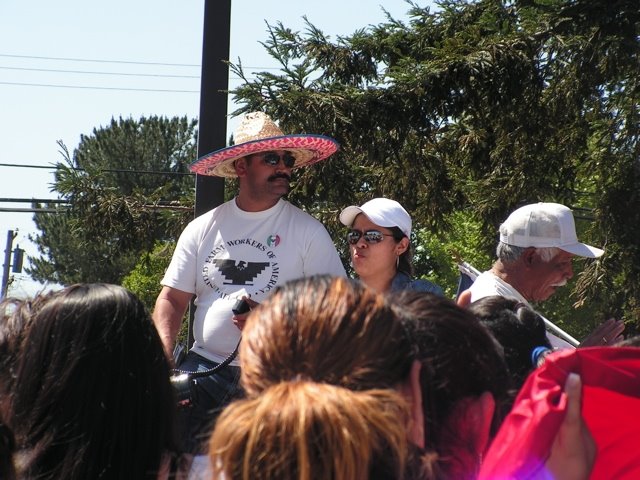
Si! se puede!


"El pueblo unido jamas sera vencido!" were the words chanted at a wonderful spirited immigration rally and march in the tiny town of Ukiah in Northern CA. Our county has only 70,000 people and thousands of mostly Latino families marched for over 3 hours in the hot sun.

Email me if you want to see the whole album on Snapfish.
cecily@birthingjourney.com

Holding my breath while pressing the send button

Oh dear.... I just turned in my final Master's Culminating project paper. It has become my 4th child over the weeks. Waking up in the night to check APA reference format, feeding the silly thing and the like. Here is my abstract.

"A question was asked if women who have a doula present during labor and birth at lower risk for unnecessary medical interventions compared with women without a doula present. A literature review suggests that the presence of a doula during labor and birth decreases the use of unnecessary medical interventions, increases positive outcomes for mother and newborn and saves money. These results led to a proposal for an in-hospital doula pilot program at [my sponsoring hospital]. Over one year, doulas would be trained and incorporated into the [my sponsoring hospital] system. Outcomes from the pilot project would be examined mid-year and end-year. If outcomes are similar to those of the research, a permanent hospital-based doula program could be incorporated."

Only one more major project, a few more papers and studying for two finals. 26 more days until graduation! Two of my dearest friends have their plane tickets in hand to come out to CA.